

Views: 0 Author: Site Editor Publish Time: 2026-10-27 Origin: Site
Designing a safe, resilient surface demands picking the perfect foundational materials. Two prominent polymers dominate the commercial and recreational flooring market today. These are Ethylene Propylene Diene Monomer (EPDM) and Styrene Butadiene Rubber (SBR). Project managers and procurement officers face a constant battle. They must balance strict budget constraints against rigorous environmental and safety demands.
Picking the wrong granular base often leads to severe problems. You might face premature surface fading, safety compliance failures, or unexpected repair bills down the line. The core trade-off usually comes down to two critical factors. You must weigh long-term aesthetic and structural durability against initial cost-effectiveness.
We created this guide to help you navigate these complex choices effectively. You will learn the core structural differences, performance metrics, and economic factors shaping each option. Armed with these insights, you can select the exact material combination that aligns perfectly with your project scope.
EPDM is the gold standard for high-exposure, multi-colored, and long-lifespan outdoor surfacing.
SBR serves as the optimal base-layer material or budget-conscious solution for low-visibility, high-impact areas.
Selecting the right granule is a balance of UV-resistance requirements, traffic volume, and long-term maintenance cycles.
Before making major procurement decisions, we must clearly define our material options. Both materials belong to the broader rubber family. However, their chemical makeup and manufacturing processes differ vastly. These fundamental differences directly impact their real-world performance.
EPDM stands for Ethylene Propylene Diene Monomer. It is a premium, virgin synthetic rubber. Manufacturers engineer EPDM rubber granules specifically for extreme weather endurance. They use specialized vulcanization processes to lock the polymer chains together tightly. The strong chemical bonding provides exceptional UV stability. This means the material resists breaking down under intense sunlight.
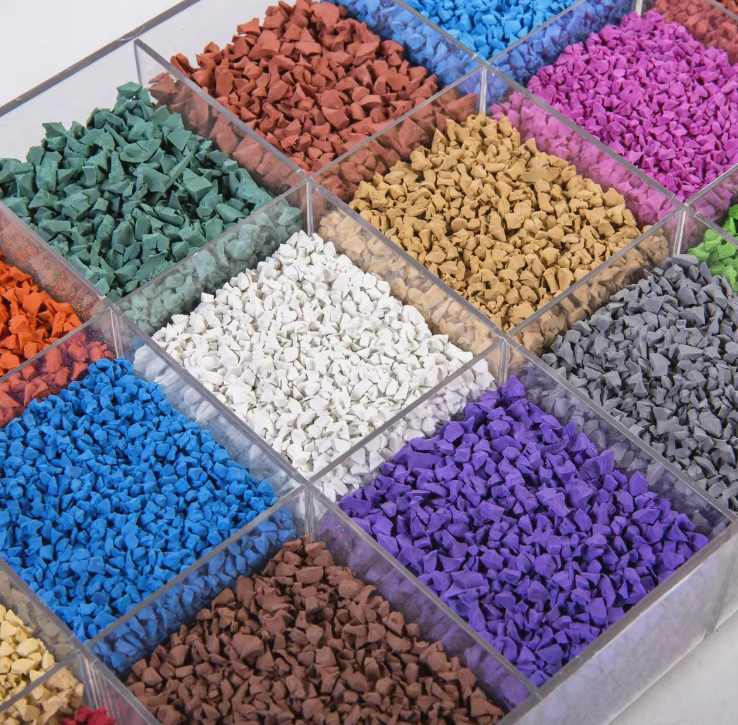
A major advantage of EPDM lies in its remarkable color retention. During production, pigments mix entirely throughout the polymer compound. If the granule wears down slightly from heavy use, the color remains vibrant. This unique trait makes it a popular choice for intricate, multi-colored surface designs.
SBR stands for Styrene Butadiene Rubber. Unlike virgin EPDM, SBR typically comes from recycled sources. Facilities process discarded vehicle tires to create SBR rubber granules. They use ambient grinding techniques to ensure consistent particle sizes. This recycling process makes SBR highly cost-efficient and environmentally beneficial regarding waste reduction.
SBR retains the robust mechanical properties of automobile tires. It offers incredible tensile strength and shock absorption. However, natural SBR is inherently black. You can dye it, but the pigment only coats the outer shell. Heavy foot traffic will eventually wear the dye away, exposing the black core.
Many successful projects do not choose just one material. Instead, they use a hybrid approach known as a poured-in-place (PIP) composite system. This method leverages the distinct strengths of both polymers. Installers pour a thick base layer of SBR. This layer provides critical shock absorption at a low cost. They then apply a thinner wear course of EPDM on top. The top EPDM layer protects the entire system from UV rays and provides vibrant aesthetics.
Evaluating performance requires looking past the spec sheet. You must thoroughly understand how these materials behave in real-world conditions. We measure overall performance across three critical pillars: weathering, safety, and elasticity.
Sunlight is the greatest enemy of synthetic surfacing. EPDM naturally resists ozone and ultraviolet radiation. Its saturated polymer backbone prevents premature oxidation. Because of this structural stability, EPDM resists cracking, shrinking, and fading under harsh sunlight.
SBR behaves entirely differently under UV exposure. The unsaturated bonds in SBR break down rapidly when exposed to intense UV rays. Unprotected SBR will harden, curl, and chalk over time. If you must use colored SBR outdoors, you need dark pigments like dark green or terracotta. You must also apply protective polyurethane coatings regularly to slow degradation.
Safety is paramount when selecting a playground rubber flooring material. EPDM is a non-toxic, virgin synthetic compound. It easily passes stringent health and safety standards. It does not release harmful volatile organic compounds (VOCs) even under intense summer heat.
SBR consists of recycled tires. It inherently contains carbon black, sulfur, and traces of heavy metals. Modern processing washes and purifies SBR extensively. It remains safe for general use. However, some project managers prefer virgin EPDM for high-contact recreational areas. This guarantees zero risk of skin irritation for young children playing directly on the surface.
Both materials excel at absorbing kinetic energy safely. This elasticity is crucial for meeting fall-height attenuation standards. Regulatory bodies use the Head Injury Criterion (HIC) to test surfaces. ASTM F1292 measures this impact attenuation to ensure safe environments.
SBR provides unmatched structural resilience. Its tire-derived origin gives it superior bounce and heavy-impact resistance. EPDM feels slightly softer underfoot. It offers excellent surface-level elasticity. By combining an SBR shock pad base beneath an EPDM wear layer, facilities easily meet and exceed strict ASTM safety standards.
Procurement teams often focus heavily on the initial price tag. However, smart budget management requires analyzing the entire economic lifecycle. You must accurately calculate ongoing operational expenditures to avoid future financial strain.
SBR holds a massive advantage in upfront capital expenditure. Because it utilizes recycled feedstocks, SBR costs significantly less per ton than virgin EPDM. For large-scale projects requiring thick shock-absorbing layers, SBR represents the only financially viable option. Using premium EPDM for a deep, 50mm base layer would rapidly exhaust a standard construction budget.
Operational expenditure paints a very different picture over a decade. Comparing EPDM vs SBR rubber granules reveals vastly different maintenance routines. EPDM surfaces demand extremely low ongoing maintenance. They usually just need routine pressure washing to remove dirt and debris. The colored pigment remains structurally stable for ten years or more.
SBR surfaces demand higher operational budgets over time. To prevent UV degradation and color loss, maintenance teams must apply a restorative polyurethane topcoat every two to three years. They must carefully power-wash the surface, let it dry completely, and roll on the chemical binder. They must also perform frequent patch repairs if the hardened SBR begins to crack. These ongoing maintenance tasks quickly consume facility budgets.
A "false economy" occurs when short-term cost-cutting measures lead to massive future expenses. Choosing cheap SBR for a highly visible, sun-drenched surface acts as a classic false economy. The initial installation quote looks highly attractive. Yet, within three short years, the surface will likely fade, harden, and crack.
Remediation is notoriously expensive. You cannot simply paint over severely cracked rubber. Contractors must rip out the failed surface entirely, dispose of the hazardous waste, and pour a new layer. Investing upfront in premium EPDM prevents this costly replacement cycle entirely.
Material selection heavily depends on the final application context. Different environments apply unique stressors to the rubber surfacing. Understanding these specific scenarios helps optimize your material choices.
EPDM dominates high-visibility sectors. Professional running tracks rely on EPDM for its reliable spike resistance and vibrant red or blue colors. Athletes depend on this consistent surface tension to maximize their sprinting speed. Luxury playgrounds heavily utilize colored rubber granules to create intricate, engaging, and themed floor patterns.
Sports courts also benefit immensely from EPDM. The material provides a highly consistent friction coefficient. This ensures athletes do not slip during sudden directional changes. The enduring color fastness guarantees the facility looks premium for years.
SBR shines brightly in utilitarian and industrial settings. Gym sub-layers endure heavy, repeated impact from dropped free weights. The visual aesthetic does not matter here because another floor covers the rubber. SBR works perfectly in this hidden environment.
Industrial walkways and anti-fatigue mats also rely heavily on SBR. Factory floors face oil spills, heavy footfalls, and constant machinery vibrations. SBR absorbs this abuse effortlessly. Its low initial cost allows facility managers to replace mats cheaply when they eventually wear out.
Smart project managers rely on advanced composite layering. This technical approach maximizes physical performance while optimizing total project investment. An ideal outdoor rubber surfacing design features two distinct functional zones.
Bottom Layer (Shock Pad): Installers use 100% SBR granules mixed with a standard aromatic polyurethane binder. This thick layer handles all kinetic energy absorption.
Top Layer (Wear Course): Installers use 100% EPDM granules mixed with a UV-stable aliphatic binder. This thin layer provides weather resistance and visual appeal.
This strategic layering consistently delivers the best of both worlds. You gain SBR's economic shock absorption and EPDM's premium surface durability.
Making the final call requires a highly systematic approach. We developed a proven four-step selection framework. This simple system guides project managers toward the most logical material choice.
First, carefully assess the environmental stressors. Measure the expected UV intensity. Will the surface sit under the blazing sun all day? If yes, EPDM becomes mandatory for the top layer. Next, evaluate foot traffic volume. High-traffic areas degrade dyed SBR surprisingly quickly. EPDM withstands heavy physical abrasion much better.
Analyze your organizational funding structure. Balance your short-term budget caps against long-term maintenance projections. If you have a rigid, low upfront budget, you may have to rely solely on SBR. However, you must document this decision and warn stakeholders about higher future maintenance costs. If you have budget flexibility, invest heavily in EPDM to reduce future liabilities.
Never compromise on public safety. Always source quality-assured granules meeting relevant industry regulations. Look for strict EN 71-3 compliance regarding non-toxicity. Check ASTM F1292 test ratings for fall height attenuation capabilities. Ensure the chosen materials readily pass regional fire retardant standards.
A poor manufacturing process ruins inherently good materials. You must conduct a strict audit of your supplier. You should evaluate rubber granule durability at the individual batch level. Follow these best practices when auditing:
Check Batch Consistency: Ensure colors match perfectly across different production runs to avoid patchy installations.
Analyze Size Distribution: Granules must remain highly uniform (e.g., 1-3mm or 1-4mm). Dust content should sit near zero.
Verify Material Purity: Ask for independent lab tests proving the EPDM polymer content exceeds the minimum acceptable threshold (usually 20-25%).
To help visualize these crucial differences, please review the summary chart below.
Material Comparison Summary
| Feature | EPDM Granules | SBR Granules |
|---|---|---|
| Material Source | Virgin synthetic rubber | Recycled tires |
| UV Resistance | Exceptional (No fading or cracking) | Low (Requires protective coatings) |
| Color Options | Vibrant, full-through coloration | Limited, mostly dyed surface layers |
| Upfront Cost | Higher capital expenditure | Lower capital expenditure |
| Best Use Case | Top wear layers, high-visibility areas | Base shock-absorbing layers, utility floors |
Use this convenient rubber granules comparison to justify your material choices to project stakeholders.
Material selection should always stem directly from specific performance requirements. Do not let initial procurement costs unilaterally dictate your entire project strategy. Balancing safety, structural longevity, and visual aesthetics requires a nuanced approach to surfacing materials.
We strongly recommend opting for EPDM on all top surface layers. This choice remains crucial where aesthetics and UV exposure are paramount. Reserve SBR specifically for structural support layers or cost-sensitive, enclosed applications. This proven composite strategy ensures maximum structural integrity without overspending your budget.
Take action today by mapping out your exact surface dimensions and exposure risks. We advise consulting with a certified surfacing specialist. They will help you evaluate your site’s specific environmental requirements and recommend the perfect granule blend.
A: SBR offers significant waste-reduction benefits because it repurposes discarded automobile tires. This action diverts millions of tons of scrap rubber from landfills. However, EPDM acts as a virgin, chemically stable polymer. It does not leach hazardous microplastics or heavy metals into the surrounding soil. Both materials possess distinct eco-friendly attributes depending entirely on your specific environmental priorities.
A: Yes, installers sometimes mix them in a "speckled" pattern to reduce overall material costs. However, doing so compromises the layer's overall longevity. The SBR granules will degrade and fade much faster than the surrounding EPDM granules. This discrepancy creates an uneven, pitted surface over time. Strategic vertical layering works much better.
A: Absolutely. EPDM naturally resists oxidative degradation caused by ambient ozone and UV radiation. SBR lacks this fundamental molecular stability. Unprotected SBR suffers from severe UV-induced weathering, causing it to harden, chalk, and lose its elastic properties within a few short years. EPDM remains highly flexible and vibrant for over a decade outdoors.
A: You should specifically look for material consistency and production transparency. Demand ISO-certified lab reports proving high polymer content (usually above 20%). Inspect physical samples for uniform granule size and absolute zero dust contamination. Reliable suppliers will gladly provide batch testing documentation and comprehensive long-term warranties protecting color stability.


