Views: 0 Author: Site Editor Publish Time: 2026-06-03 Origin: Site
Investing in an outdoor badminton court carries much higher operational risks than building indoor facilities. You must account for completely uncontrolled environmental variables. Harsh UV exposure, relentless moisture, and sudden temperature fluctuations constantly attack outdoor surfaces. Selecting the wrong material inevitably leads to rapid degradation. You will quickly notice unsightly surface cracking, material peeling, and severe color fading. Worse, improper surfaces drastically increase player injury risks during intense matches. Hard concrete bases cause severe knee and ankle strain. Poor material choices also inflate your long-term maintenance needs.
You need a reliable way to transition from simply browsing options to actively evaluating them. This article provides a definitive, standard-aligned framework. We will help you select a surface matching your exact facility needs. You will learn how to properly balance player safety, all-weather durability, and long-term value.
Outdoor badminton flooring must explicitly solve for UV resistance, thermal expansion, and water drainage—standard indoor PVC or hardwood will fail.
The primary viable outdoor options are Interlocking Suspended Tiles (PP), Hard/Cushion Acrylic, and Silicone Polyurethane (SPU).
Silicone Polyurethane court coating currently offers the highest shock absorption and player safety for permanent outdoor concrete or asphalt bases.
Subfloor preparation (grading and moisture barriers) accounts for up to 50% of the court's ultimate lifespan and performance.
You must scrutinize outdoor environments closely before planning a facility. The natural elements rapidly destroy standard indoor sports floors. You cannot simply install an indoor mat outside and expect good results.
Constant sun exposure degrades non-treated polymers. Ultraviolet rays actively break down chemical bonds inside cheap plastics. This chemical degradation leads to rapid surface hardening. Players experience a dangerous loss of traction as the floor loses its elasticity. You must prioritize UV-stabilized materials for any outdoor project. Premium manufacturers infuse their resins directly against UV breakdown. Furthermore, rain constantly disrupts play schedules. You need a highly hydrophobic surface. Water-repellent materials ensure rapid post-rain recovery. Good drainage keeps the court available for peak usage hours. It prevents algae growth across the playing zone.
Player safety remains paramount in modern court design. A primary Voice of Customer (VoC) concern highlights a serious issue. Outdoor concrete bases cause severe joint impact. Every jump smash and deep lunge forces kinetic energy directly back into the player's knees. A badminton player often lands generating forces three times their body weight. Your chosen flooring must provide a measurable Vertical Deformation rate. It must also deliver adequate Shock Absorption. We recommend targeting BWF-aligned recreational standards for impact reduction. High-quality shock absorption significantly extends playing time. It successfully prevents chronic joint pain among frequent players.
Badminton requires aggressive lunges and lightning-fast pivots. You must balance the ability to pivot smoothly against preventing accidental slips. Humid or dusty outdoor conditions change traction instantly. A micro-textured surface provides the ideal Coefficient of Friction. It grips the shoe firmly during sudden stops. However, it releases smoothly during a rotational twist. This delicate balance prevents severe ankle sprains and meniscus tears. Too much grip locks the foot dangerously. Too little grip causes disastrous sliding.
Let us examine the primary categories available for modern outdoor builds. You will find distinct advantages and disadvantages across these top contenders.
These modular plastic tiles snap together effortlessly. You commonly see them in public parks and temporary event spaces.
Pros: You gain rapid installation speeds. A small team can assemble a court in a single afternoon. They remain highly portable and easily removable. This addresses temporary court needs perfectly. The open-grid design offers excellent passive drainage. Rainwater falls straight through the surface to the ground below.
Pros: You do not need adhesives or complex curing times. You simply lock the tiles over a flat driveway or pre-paved area.
Cons: Polypropylene can warp significantly under extreme summer heat. PP tiles provide much lower shock absorption unless you install dedicated rubber underlayments underneath them. Players often dislike the "hollow" acoustic feedback during heavy footwork. The plastic emits a loud clacking sound upon impact.
Acrylic paints dominate tennis courts globally. They also serve basic badminton facilities quite well.
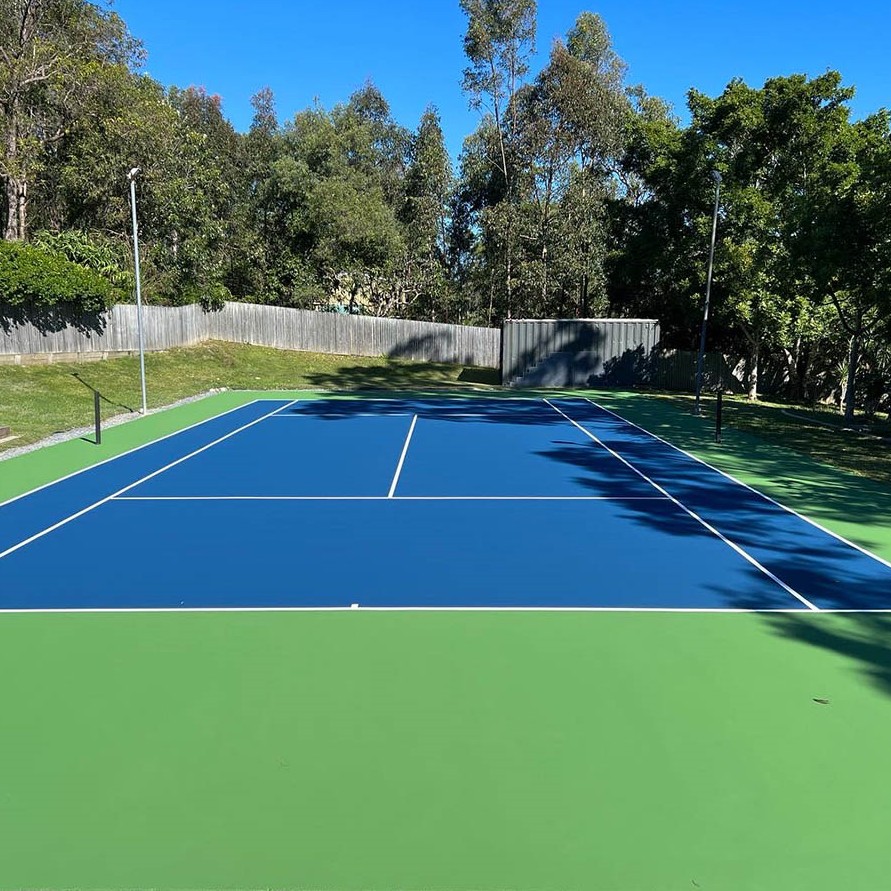
Pros: They are highly cost-effective to install upfront. Acrylics prove exceptionally durable against heavy daily foot traffic. You can easily resurface them later by rolling on a new coat. They also produce zero glare under bright sunlight. The matte finish helps players track the shuttlecock easily.
Cons: Hard acrylic offers absolutely zero shock absorption. The paint merely coats the rigid concrete. Cushion acrylic feels slightly better. It incorporates tiny rubber granules. However, it remains quite rigid compared to advanced elastomers. You face a high risk of surface cracking if the concrete subfloor shifts or settles.
This premium system dominates professional permanent outdoor facilities. It brings indoor biomechanical benefits into an outdoor environment.
Pros: You get a completely seamless, highly elastic playing surface. It delivers superior kinetic energy return. Silicone Polyurethane court coating remains exceptionally weather-resistant across all seasons. The surface dynamically yields to player footwork.
Cons: Installers need precise weather conditions during the liquid curing phases. You face a higher initial expenditure upfront. The installation process demands specialized contractors rather than general laborers.
Flooring Type | Shock Absorption | Installation Speed | Weather Resistance | Best Application |
|---|---|---|---|---|
Interlocking Tiles (PP) | Low to Medium | Very Fast (1-2 days) | Good (Heat warping risk) | Temporary / Portable Courts |
Hard/Cushion Acrylic | Very Low | Moderate (3-5 days) | Excellent | Casual / Public Facilities |
Silicone PU Coating | High (Professional) | Slow (7-10 days) | Excellent | Permanent / Premium Clubs |
Facility owners frequently ask why professionals overwhelmingly prefer specific elastomers. Let us thoroughly break down the multi-layer structure of Silicone Polyurethane court coating. This material truly sets the benchmark for outdoor badminton performance.
This specific coating relies on a precise structural hierarchy. Each chemical layer serves a critical biomechanical function. You cannot skip layers without ruining the final performance.
Primer Layer: This thin liquid layer deeply seals the subfloor. It creates an unbreakable chemical bond. It prevents groundwater moisture from rising and ruining the upper layers.
Elastic Buffer Layer: This thick middle section actively absorbs impact energy. It protects player joints during heavy, repetitive footwork. It compresses slightly under pressure. This layer provides the signature "bounce" players love.
Reinforced Topcoat: The final layer features advanced silicon-modified resins. This specialized wear layer resists dirt build-up. It deflects aggressive shoe scuffs effortlessly. It also combats severe UV fading better than traditional polyurethane.
A properly installed SPU surface yields an impressive 8-to-12-year lifespan. You rarely need major interventions before requiring a simple topcoat refresh. This avoids the expensive total tear-downs typically associated with cheap roll-out mats. You essentially renew the entire court just by rolling on a fresh, thin top layer every decade. The thick buffer layer remains completely intact beneath it.
SPU successfully mimics the uniform bounce of professional indoor BWF-certified mats. Players immediately experience a secure grip and highly consistent footwork feedback. The shuttlecock bounces predictably across every inch of the floor. This reliable performance makes it the preferred choice for high-end residential, club, or institutional builds. Professional players easily transition from indoor tournaments to an outdoor SPU court without altering their footwork mechanics.
No premium coating can fix a fundamentally bad foundation. You must execute flawless civil works before pouring any resins. A perfect topcoat sitting on a cracking subfloor remains completely useless.
You typically choose between concrete and asphalt bases. Each requires distinct preparation methods. Concrete demands a full 28-day curing period. It requires rigorous vapor barriers underneath to prevent rising dampness. Installers must also perform professional acid etching or mechanical grinding. This opens the concrete pores for better primer adhesion. Asphalt requires a 14-day curing time. It needs specialized pore-sealing instead of etching. However, asphalt offers significantly better natural flexibility. This native flexibility dramatically reduces surface cracking risks over time. Many premium courts utilize an asphalt base for this exact reason.
Standing water heavily accelerates the degradation of any coating. You must define and strictly enforce a standard required slope. Experts strongly recommend a continuous slope of 0.5% to 1%. This slight angle pushes rainwater off the court naturally. It efficiently prevents puddles without noticeably affecting gameplay or player balance. You must test this slope meticulously before applying the primer.
You face stringent environmental requirements when installing poured or coated systems. The ambient temperature must remain consistently above 10°C. You also need an absolutely zero rain forecast for 48 to 72 hours. Raindrops falling on uncured liquid resins cause severe topcoat bubbling. Wind can also blow debris and dust into the wet surface. You must hire experienced, specialized contractors. They understand local micro-climates and know exactly when to pour the resins safely.
How do you make the ultimate procurement decision? You must strictly align material strengths against your specific facility goals. We developed a straightforward decision matrix tool to clarify your final choices.
Facility Goal & Scenario | Recommended Flooring Choice | Core Reasoning |
|---|---|---|
You need a portable, temporary court or have severe standing water issues. | Interlocking PP Tiles | You can easily pack them up, move locations, and ignore minor subfloor moisture. |
You are building a casual park facility and face heavy budget constraints. | Hard / Cushion Acrylic | It delivers extreme wear resistance for low-impact, recreational public use. |
You demand professional biomechanics, player safety, and permanent durability. | Silicone PU Coating | It provides unparalleled joint protection, true bounce, and mimics indoor professional standards. |
You should specify the premium coating option when you expect uncompromising, professional-grade performance. Long-term durability and athlete safety always justify selecting the highest quality elastomer available.
Outdoor badminton courts face incredibly unique environmental hostilities. Relentless sun, extreme summer heat, and heavy rain rule out traditional indoor materials completely. You must adapt your facility procurement strategy accordingly. You cannot compromise on material science.
We advise decision-makers to prioritize subfloor preparation above all else. Never cut corners on your concrete or asphalt foundation. Carefully weigh the long-term biomechanical benefits of elastomeric surfaces. Options like SPU dramatically enhance player comfort, extend playing times, and ensure overall safety. They represent the true gold standard for outdoor builds.
We strongly prompt you to request a professional site evaluation immediately. Ask trusted manufacturers for physical material samples. Test the surface traction, evaluate the glare reduction, and feel the material density firsthand. You must experience the kinetic return before you commit to any large procurement contract.
A: No. Standard PVC roll-out mats lack vital UV stabilizers. They will curl, shrink, and harden rapidly under direct sunlight. Furthermore, they trap rainwater underneath the surface. This trapped moisture causes severe mold growth and immediate subfloor rot. You must use materials explicitly engineered for outdoor weather.
A: Interlocking PP (Polypropylene) suspended tiles serve this need best. They snap together quickly without specialized tools. You can place them securely over existing flat driveways or compacted grass areas. They are also easily disassembled for compact winter storage.
A: Specify a matte or heavily textured finish. Premium options like Silicone Polyurethane court coating or texturized acrylics utilize fine sand aggregates in the final wear layer. These embedded aggregates successfully diffuse harsh sunlight. This significantly improves the visual tracking of the flying shuttlecock.
A: It depends heavily on the surface material and subfloor slope. Suspended open-grid tiles drain almost instantly. SPU or acrylic courts built upon a proper 1% slope dry very quickly. Equipped with a hydrophobic topcoat, you can squeegee them and resume active play within 15 to 30 minutes after the rain stops.