

Views: 0 Author: Site Editor Publish Time: 2026-10-20 Origin: Site
Upgrading or installing a playground surface requires balancing critical fall safety, long-term durability, and aesthetic requirements. Facility managers must protect children from high falls while ensuring the chosen materials withstand harsh weather conditions. The stakes remain incredibly high for public parks and schools alike.
However, not all playground surfacing material is created equal. Low-grade rubber often leads to premature surface degradation. It suffers from rapid color fading under direct sunlight. Poor quality materials directly compromise essential impact attenuation. This exposes children to severe injury risks and opens facilities to significant legal liabilities.
We provide a reliable framework for evaluating EPDM rubber granules based on polymer content, safety compliance, and installation realities. You will learn how to scrutinize supplier specifications effectively. You will also understand how to verify chemical safety and avoid disastrous installation mistakes. Following these guidelines ensures a high-return, long-lasting investment for your facility.
Polymer Content Dictates Lifespan: Granules with 20–25% pure EPDM polymer content offer the optimal balance of elasticity and durability.
Safety is Measurable: Material selection must directly support Critical Fall Height (CFH) and Head Injury Criterion (HIC) standards (e.g., ASTM F1292).
Installation Variables Matter: Even premium wet pour rubber granules will fail if paired with the wrong polyurethane binder or installed in improper weather conditions.
Verify Before Buying: Always request technical data sheets (TDS) and independent lab testing certificates before shortlisting a supplier.
A successful installation demands more than bright colors and attractive designs. You must focus on measurable performance metrics and user experiences. When you select EPDM playground flooring, you evaluate long-term resilience alongside daily usability.
Accessibility remains a non-negotiable standard for modern public spaces. Bonded EPDM surfaces provide smooth, firm navigation pathways. They easily meet ADA (Americans with Disabilities Act) compliance for wheelchair and mobility device access. Loose-fill alternatives like wood chips or sand create physical barriers. Wheels sink easily into loose materials, isolating children with physical disabilities. Poured rubber eliminates these barriers entirely. Children of all mobility levels can play together seamlessly on a unified, stable ground.
Safety predictability serves as a primary business goal for any recreational facility. You want immediate liability reduction. You achieve this through consistent, verifiable impact absorption across all weather conditions. Loose materials displace easily under heavy-use areas like swings and slides. This displacement leaves dangerous hard spots over time. Bonded EPDM surfaces never displace. They maintain exact cushioning properties year-round. You know exactly how the surface performs during a freeze or a summer heatwave.
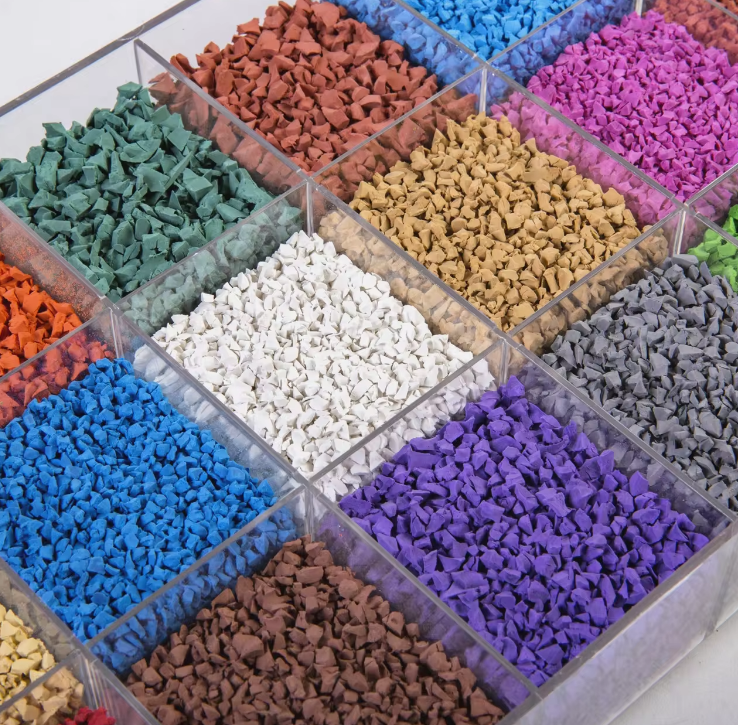
You cannot evaluate playground rubber granules purely by visual inspection. You must examine the hidden chemical and physical properties.
Industry experts dictate a 20–25% polymer ratio for commercial safety playground flooring. This exact ratio delivers the perfect balance of elasticity and long-term durability. If polymer content falls below 20%, granules become brittle. They will crack under heavy foot traffic. If content exceeds 25%, the surface becomes overly soft and unnecessarily expensive.
Specific gravity and density demand equal attention during procurement. Low-density granules contain excess air pockets. They act like microscopic sponges. Overly porous granules absorb massive amounts of polyurethane binder during installation. Polyurethane binder remains highly expensive. This absorption drives up total project costs dramatically. High-density granules require less binder while providing superior structural integrity.
Best Practice: Always request the manufacturer's Technical Data Sheet (TDS) to verify the 20-25% polymer ratio before authorizing a purchase.
Common Mistake: Buying granules based solely on weight without checking specific gravity. This leads to massive cost overruns during the binder mixing phase.
Elasticity prevents catastrophic surface failure. Granules must stretch and recover repeatedly without permanent deformation. Playgrounds face constant jumping, running, and thermal expansion. Direct sun exposure causes rubber to expand. Cold nights cause it to contract. High tensile strength ensures the surface withstands these relentless forces without tearing apart.
You must scrutinize colored rubber granules for UV stability. We acknowledge that all dyed rubber eventually experiences minor UV degradation. Sun exposure naturally breaks down chemical pigments over decades. However, manufacturing methods matter immensely here.
Premium peroxide-cured granules resist chalking and fading significantly longer than cheaper sulfur-cured alternatives. Sulfur-cured rubber often hardens, fades rapidly, and transfers colored residue onto children's clothing. Peroxide curing creates stronger molecular bonds, locking the pigment inside the rubber matrix securely.
Comparison of EPDM Curing Methods
| Feature | Peroxide-Cured EPDM | Sulfur-Cured EPDM |
|---|---|---|
| UV Stability | Excellent; resists fading and chalking. | Poor; prone to rapid fading in sunlight. |
| Color Retention | Maintains bright, vibrant hues for years. | Colors dull and wash out quickly. |
| Physical Durability | High tensile strength; resists hardening. | Hardens and becomes brittle over time. |
| Cost Profile | Higher initial material cost. | Lower initial material cost. |
Fall protection remains the absolute priority for any installation. Material selection directly influences child safety and facility compliance. You must demand documented proof of these standards.
EPDM rubber granules for playgrounds must absorb extreme kinetic energy. Installers build these protective systems in two specific layers. They lay down a thick base layer of recycled SBR (Styrene-Butadiene Rubber) buffings. They cover this base with a vibrant top layer of EPDM. These layers work in tandem.
Together, they meet strict Critical Fall Height (CFH) ratings. If a play structure stands ten feet tall, the surface must safely absorb a ten-foot fall. Technicians use instrumented headforms to measure G-force upon impact. The Head Injury Criterion (HIC) score must remain strictly below 1000 to pass safety regulations.
Children frequently touch the ground and then their faces. You must demand strict chemical verification for all materials. The granules must remain entirely free from heavy metals, phthalates, and toxic volatile organic compounds (VOCs). Reputable manufacturers always test their products against EN 71-3 standards. This European standard ensures no toxic chemicals leach out during physical contact or rain exposure.
Wet weather creates severe slipping hazards on poorly designed surfaces. The granule surface texture provides essential friction. Proper granulation sizing creates a reliable micro-textured grip. This grip catches shoe treads effectively. Smooth surfaces become dangerous ice rinks during light rain. Textured granules keep the play area safe year-round, minimizing slip-and-fall liabilities.
Premium materials cannot survive poor installation methods. Working with wet pour rubber granules requires precise chemical pairing and strict environmental controls.
Most commercial contractors utilize a standard two-tier poured-in-place (PIP) system. The bottom layer consists of recycled SBR rubber. SBR provides maximum shock absorption at a highly economical price. The top wear layer consists of 10mm–15mm of virgin EPDM. This crucial top layer handles daily abrasion, provides UV resistance, and delivers vibrant aesthetic colors.
Best Practice: Ensure your installer uses a specialized screed box for even distribution of the SBR base layer. This guarantees consistent shock absorption across the entire footprint.
Common Mistake: Skimping on the base layer thickness to save money. This directly lowers the CFH rating and exposes the facility to severe legal liabilities.
Polyurethane binder holds the entire system together. Binder selection creates a massive implementation risk. Many contractors use cheaper aromatic binders to lower their bids. Aromatic binders turn yellow or "amber" under direct UV light.
If you mix an aromatic binder with light blue granules, the yellowing effect turns the surface green. We highly recommend utilizing aliphatic binders for high-visibility colors. Aliphatic binders cost more initially but remain crystal clear over their entire lifespan. They protect the original granule color perfectly.
Binder Compatibility Summary Chart
| Binder Type | Visual Impact over Time | Best Used For | Cost Level |
|---|---|---|---|
| Aromatic Polyurethane | Yellows (ambers) under UV light. | Black, dark green, or dark red granules. | Low to Moderate |
| Aliphatic Polyurethane | Remains crystal clear; no yellowing. | Blue, white, yellow, and bright mixed colors. | High |
Weather dictates installation success entirely. Temperature and humidity directly control polyurethane cure times. If contractors pour rubber in extreme humidity, the binder will foam. Foaming weakens the molecular bonds, leading to premature crumbling.
If temperatures drop too low, the binder refuses to cure. The surface remains sticky and unusable. You must schedule installations during optimal weather windows. Installers require dry conditions with temperatures consistently above 50°F (10°C) for proper curing.
Choosing a manufacturing partner requires intense due diligence. You must screen suppliers carefully to avoid costly material failures.
Watch out for suppliers refusing to provide third-party testing data. Walk away immediately if they hide these documents. If vendors offer prices drastically below the market average, proceed with extreme caution. Disreputable vendors often substitute cheap recycled rubber. They dye it and masquerade it as virgin EPDM. You can often spot this deception by cutting a granule in half. If the inside appears black while the outside is colored, it is dyed recycled rubber.
You should ask these precise questions before signing any contracts:
"Can you provide a recent Technical Data Sheet (TDS) for this specific batch?"
"What is the exact recommended granule-to-binder ratio for this product?"
"Do you possess independent laboratory certificates for EN 71-3 chemical compliance?"
"Are these granules peroxide-cured or sulfur-cured?"
Always request physical samples before making financial commitments. You need to assess color consistency under natural sunlight visually. Perform a quick dust test upon receiving the sample. Rub the granules against a white sheet of paper. High dust content ruins polyurethane adhesion, causing the surface to shed rapidly.
Additionally, verify the granule sizing manually. The industry standard typically requires 1.0mm to 4.0mm granules for top layers. This specific size range prevents picking and ensures a tightly bonded, smooth finish.
Selecting EPDM materials demands careful, technical analysis. It relies heavily on precise polymer ratios, measurable UV stability, and rigorous safety testing rather than just aesthetic appeal. Quality materials prevent premature surface failure and ensure consistent impact attenuation over decades of heavy use.
We strongly advise prioritizing suppliers who provide fully transparent compliance documents. Ask them to advise you proactively on correct binder pairings for your regional climate. Request physical samples and verify the curing methods before ordering. Taking these deliberate steps ensures long-lasting surface integrity. It also provides essential liability protection for your organization, keeping children safe year-round.
A: Typically, 1.0mm to 4.0mm is used for the top wear layer. This specific sizing ensures a smooth, tightly bonded surface. It actively resists picking, vandalism, and daily degradation from heavy foot traffic.
A: With high-quality material and proper maintenance, it generally lasts 10 to 15 years. After this period, you might need a top-coat recoat or targeted patching in high-wear zones like under swings or slide exits.
A: Yes. Wet pour systems allow for limitless custom color blending. Installers easily integrate educational graphics, school logos, and safety zoning directly into the safety surface during the liquid pour phase.
A: Darker colors will absorb more heat. It is a known implementation reality that rubber surfaces get hot. We highly recommend utilizing lighter colors or implementing artificial shading structures in hot climates to prevent accidental contact burns.


