Views: 0 Author: Site Editor Publish Time: 2026-06-30 Origin: Site
A visible shift is actively transforming urban planning and facility management worldwide. Standard green and red public courts are rapidly transitioning into vibrant, multi-colored designs. These eye-catching installations now dominate city parks, schoolyards, and community recreation centers. This trend goes far beyond simple aesthetic preference. Planners leverage these bold designs as strategic assets to boost community engagement and maximize facility utilization.
However, facility operators face a complex operational reality when executing these dynamic visual concepts. You must balance striking visual impact with athletic performance, daily longevity, and maintenance practicality. In this article, you will discover how modern material chemistry supports these vibrant civic upgrades. We will explore performance evaluation, risk mitigation, and actionable rollout strategies for your next successful public court project.
Community Impact: Vibrant courts increase utilization rates, deter vandalism, and modernize aging public infrastructure.
Performance Matters: High-contrast colors improve boundary visibility for multi-sport (e.g., tennis converted to pickleball), but require careful thermal and glare management.
Material Selection: Achieving lasting vibrancy without compromising biomechanics requires advanced surfacing, with Silicone Polyurethane court coating emerging as the industry standard.
Risk Mitigation: Successful rollouts depend on UV-resistant pigments, proper substrate preparation, and strategic color choices to avoid surface overheating.
Aging urban parks often suffer from low foot traffic and neglect. Custom colors and artistic court designs breathe new life into these spaces. They transform ordinary playing surfaces into local landmarks. Residents feel a stronger sense of community ownership when their neighborhoods feature bespoke, high-quality public assets. This psychological shift directly impacts facility maintenance. Increased foot traffic naturally deters vandalism. Communities protect spaces they actively use and value. A visually stimulating court invites players of all ages, driving daily engagement and restoring purpose to forgotten urban corners.
Space constraints force modern urban planners to maximize every square foot. Public courts rarely serve a single sport anymore. You routinely see basketball, pickleball, and futsal overlapping on a single footprint. This creates significant confusion for players if the court only uses traditional line striping. Distinct color-blocking solves this issue elegantly. Facility managers use contrasting hues to demarcate overlapping play areas. A solid blue perimeter might indicate the futsal boundary, while a bright orange interior clearly defines the basketball key. Players instantly recognize their designated zones. This strategy improves safety, reduces player disputes, and accommodates multiple community groups simultaneously.
Visually striking courts generate significant attention. They act as powerful civic branding tools. A beautiful, high-design court attracts community grants and local sponsorships. Businesses want their names associated with vibrant, successful public projects. Furthermore, these courts offer immense social media visibility. Players frequently record and share games on customized, colorful surfaces. This digital exposure helps municipal parks departments justify renovation budgets. It proves the immediate public value of their investments. When a city unveils a dynamic sports facility, it signals progress, inclusion, and a commitment to public health.
Bold designs look phenomenal in drone photographs. However, they can sometimes frustrate the actual athletes. Professional tournament rollouts occasionally receive negative user feedback regarding overly saturated colors. High-intensity pigments can cause eye strain during extended play. They may also create severe ball tracking issues. A bright yellow tennis ball easily disappears against a neon green or highly patterned background. Facility designers must prioritize player experience over pure aesthetics. You should reserve intricate, highly saturated patterns for out-of-bounds border areas. Keep the primary playing surface focused, solid, and visually supportive of the sporting equipment.
Color choice directly impacts surface temperature. Different pigments absorb sunlight at drastically different rates. Darker colors naturally absorb more heat. A deep black or navy blue court can become uncomfortably hot during summer months. This excess heat radiates upward, severely impacting player stamina. It also forces the underlying material to expand and contract aggressively. Thermal expansion leads to premature wear if the coating lacks elasticity. Facility managers must analyze these heat-retention differences carefully.
Pigment Tone | Heat Absorption | Player Comfort Impact | Material Stress |
|---|---|---|---|
Dark (Black, Deep Red, Navy) | High | Radiates heat; lowers stamina | High thermal expansion |
Medium (Standard Blue, Green) | Moderate | Standard playing conditions | Moderate expansion |
Light (Light Gray, Pastel Blue) | Low | Cooler surface; extended play | Low thermal stress |
Direct sunlight creates dangerous glare on highly reflective surfaces. Players need a matte finish to track the ball safely and maintain balance. However, overly textured matte surfaces trap dirt easily. They become difficult to clean and maintain over time. Planners must strike a delicate balance here. You need a topcoat that diffuses light effectively while retaining enough smoothness to resist tire marks and dust buildup. Advanced polyurethane systems address this by using specialized silica additives. These additives scatter sunlight without creating a porous, dirt-trapping texture.
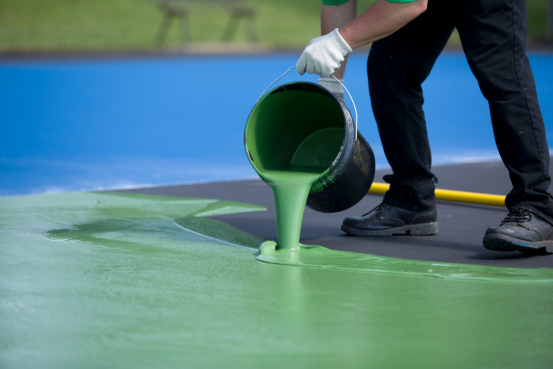
A successful public court requires more than vibrant paint. It demands structural integrity and player safety. Silicone Polyurethane court coating perfectly bridges this gap. It provides necessary shock absorption and vital joint protection. The multi-layered elastomeric system cushions player impact, reducing lower body injuries. Unlike rigid concrete or thin acrylics, Silicone PU yields slightly underfoot. Crucially, it achieves these biomechanical benefits while fully supporting vibrant, customizable pigments. You do not have to sacrifice athletic performance for civic aesthetics.
Sustained sun exposure destroys cheap paints quickly. Traditional acrylic surfaces often suffer from severe chalking, fading, and discoloration within a few years. Silicone PU systems solve this degradation problem through advanced chemistry. They utilize aliphatic polyurethane topcoats. Aliphatic compounds are inherently UV-stable. They do not yellow or break down under intense ultraviolet radiation. This chemical stability locks the pigment into the surface. The bright reds, blues, and yellows remain vibrant long after application. This long-term color retention makes Silicone PU superior for high-visibility public projects.
Public courts face brutal environmental conditions. They endure freezing winters and blistering summers. Standard outdoor paints lack the flexibility to survive these temperature fluctuations. They become brittle and develop widespread micro-cracking. Silicone PU maintains its structural integrity across extreme temperature ranges. It stretches and contracts without breaking its continuous membrane. This all-weather durability prevents moisture from penetrating the base layer. It significantly reduces the massive frost-heave damage commonly seen in standard municipal facilities.
Municipalities rarely build new courts from scratch. They usually renovate existing, degraded surfaces. You need a material that bonds aggressively to old infrastructure. Silicone PU boasts exceptional adhesion capabilities. It bonds seamlessly with both asphalt and concrete substrates during facility retrofits. This multipurpose suitability simplifies the renovation process. The primer layer deeply penetrates the existing porous surface, creating a permanent mechanical bond. It acts as an optimal bridge between the old foundation and the new, vibrant playing surface.
Chart: Material Comparison Summary | ||
Feature | Standard Acrylic Paint | Silicone PU System |
|---|---|---|
Shock Absorption | Low (Rigid surface) | High (Elastomeric cushioning) |
UV Stability | Moderate (Fades over time) | Excellent (Aliphatic topcoat) |
Crack Resistance | Low (Brittle under stress) | High (Flexible membrane) |
Substrate Adhesion | Good on clean concrete | Superior on asphalt & concrete |
You cannot build a durable court on a failing foundation. High-end colorful coatings require rigorous substrate preparation. Moisture vapor transmission ruins polyurethane systems if ignored. You must conduct thorough moisture-barrier testing before pouring any chemical layers. If the concrete lacks a proper vapor barrier, trapped water will push upward and blister the new surface. Furthermore, all structural cracks require professional remediation. You must fill and seal them properly. Skipping these assessment steps guarantees a rapid, costly surface failure.
Budgeting for advanced surfaces requires a long-term perspective. Evaluating the financial impact means looking beyond the initial invoice. Silicone PU systems require a higher upfront investment compared to standard acrylic paint. The installation involves multiple poured layers and specialized labor. However, this initial cost heavily offsets future expenditures. You benefit from significantly reduced recoating frequencies. A well-installed system drastically lowers annual maintenance costs. Facility managers spend less time patching cracks, repainting faded lines, and dealing with weather damage over the ensuing decade.
Material chemistry only performs as well as the installation crew. You must evaluate vendors rigorously. Prioritize contractors who demonstrate specific experience with multi-layer polyurethane systems. Standard painters cannot install these floors correctly. The material requires precise mixing ratios and specific curing times.
Verify their portfolio of past outdoor installations.
Check their references regarding long-term surface durability.
Assess their custom line-marking precision for multi-sport overlays.
Ensure they own the proper screeding and application equipment.
Artistic designs must never violate sporting rules. The chosen surface still serves athletes first. You must ensure the final product meets strict industry guidelines. Certifications matter deeply for competitive play. The International Tennis Federation (ITF) dictates specific pace ratings and ball-bounce standards. FIBA mandates strict slip-resistance metrics for basketball. Experienced contractors can balance vivid pigments with compliant surface textures. They adjust the final silica topcoat to match these international standards flawlessly.
Do not select colors in a vacuum. You must conduct a localized environmental audit first. Assess the court's daily sun exposure. A court bathed in intense afternoon sun requires lighter, heat-reflective shades. Next, evaluate the surrounding tree canopy. Overhanging trees drop sap, leaves, and berries. These elements severely stain light-colored surfaces. Analyze your average local temperatures to rule out problematic color palettes immediately. A dark purple court might work perfectly in a cool coastal city, but it will fail miserably in a desert climate.
You must prioritize visibility over artistic preference. Verify the contrast ratios between your proposed surface color and the primary sporting equipment. If you install a multipurpose court, test the most common items used. A vibrant orange court looks stunning, but an orange basketball becomes nearly invisible against it. Yellow pickleballs disappear entirely on bright green or neon yellow surfaces. Create a digital mockup and lay the actual equipment colors over the design. This simple test prevents disastrous player experiences.
Never approve a massive public rollout based on a digital PDF. Screen colors behave differently than physical chemicals in sunlight. Request physical material samples of your specific Silicone Polyurethane court coating. Ask the manufacturer to provide these samples in your exact desired colors. Take these physical swatches outdoors. Test their wet-slip resistance manually. Observe their glare under actual midday lighting conditions. This physical proofing stage guarantees the final installation matches both your aesthetic vision and your safety requirements.
Colorful sports courts represent a highly functional civic upgrade, not merely a fleeting architectural trend. They actively revitalize neighborhoods, encourage athletic participation, and modernize overlapping recreational spaces. However, the true success of a vibrant court relies entirely on the durability of the underlying chemistry. Superficial paints will inevitably crack, fade, and disappoint the community. Decision-makers must prioritize UV-stable, high-shock-absorption materials like Silicone PU before finalizing any aesthetic designs. We strongly recommend requesting physical material samples and scheduling a professional substrate consultation as your immediate next step.
A: Yes. Dark pigments (blacks, deep purples, dark reds) absorb more infrared radiation, which can increase surface temperatures. Facility managers in hot climates should prioritize lighter colors or specify heat-reflective topcoats.
A: With proper UV-stable aliphatic topcoats, a high-quality Silicone PU court can maintain color vibrancy and structural integrity for 8 to 12 years before requiring a recoat, significantly outlasting standard acrylic paints.
A: Yes, but surface preparation is critical. Existing cracks must be filled, and a proper primer must be applied. For best performance, applying a seamless elastomeric layer (like Silicone PU) over the asphalt is recommended to prevent reflective cracking.
A: They can if poorly designed. Best practices dictate keeping the primary playing areas (e.g., inside the three-point line or the tennis baseline) in solid, high-contrast, non-distracting colors, reserving intricate patterns for the out-of-bounds or border areas.