

Views: 10 Author: Site Editor Publish Time: 2026-09-17 Origin: Site
A newly built running track looks impressive on day one. But within 12 to 24 months, many facility managers notice troubling signs — surface cracking along the inner lanes, granules pulling loose under spike impact, color fading unevenly across sun-exposed sections, and an increasingly hard surface that no longer provides adequate shock absorption.
These problems rarely stem from a single cause. In most cases, the root issue traces back to the material at the core of the surface layer: EPDM rubber granules. When EPDM granules are selected without proper technical evaluation — or when incompatible grades are used for the wrong layer — the entire track system underperforms, regardless of how well it was installed.
This guide explains what EPDM rubber granules are, how they function within a running track system, what performance parameters actually matter, and how to make informed
procurement decisions that protect both your project timeline and long-term surface integrity.
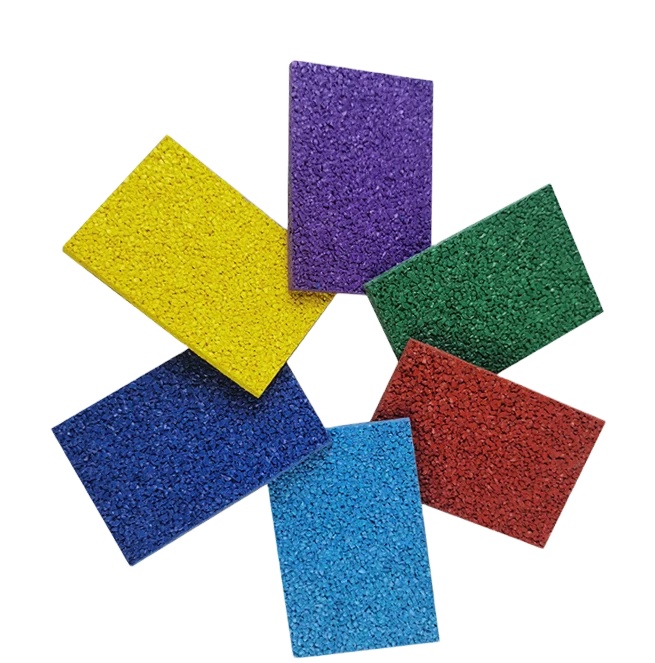
EPDM rubber granules are engineered particles made from ethylene propylene diene monomer — a synthetic rubber produced by polymerizing ethylene, propylene, and a small amount of non-conjugated diene. The resulting material has a fully saturated carbon-carbon backbone, which gives it exceptional resistance to ozone, UV radiation, and thermal oxidation compared to natural rubber or general-purpose SBR compounds.
In a running track system, EPDM granules serve as the functional aggregate. They are mixed with a polyurethane (PU) binder and either troweled, poured, or spray-applied to form the elastic surface layer that athletes interact with directly. Depending on the track type, EPDM granules may appear in the wearing course, the shock-absorbing base layer, or both.
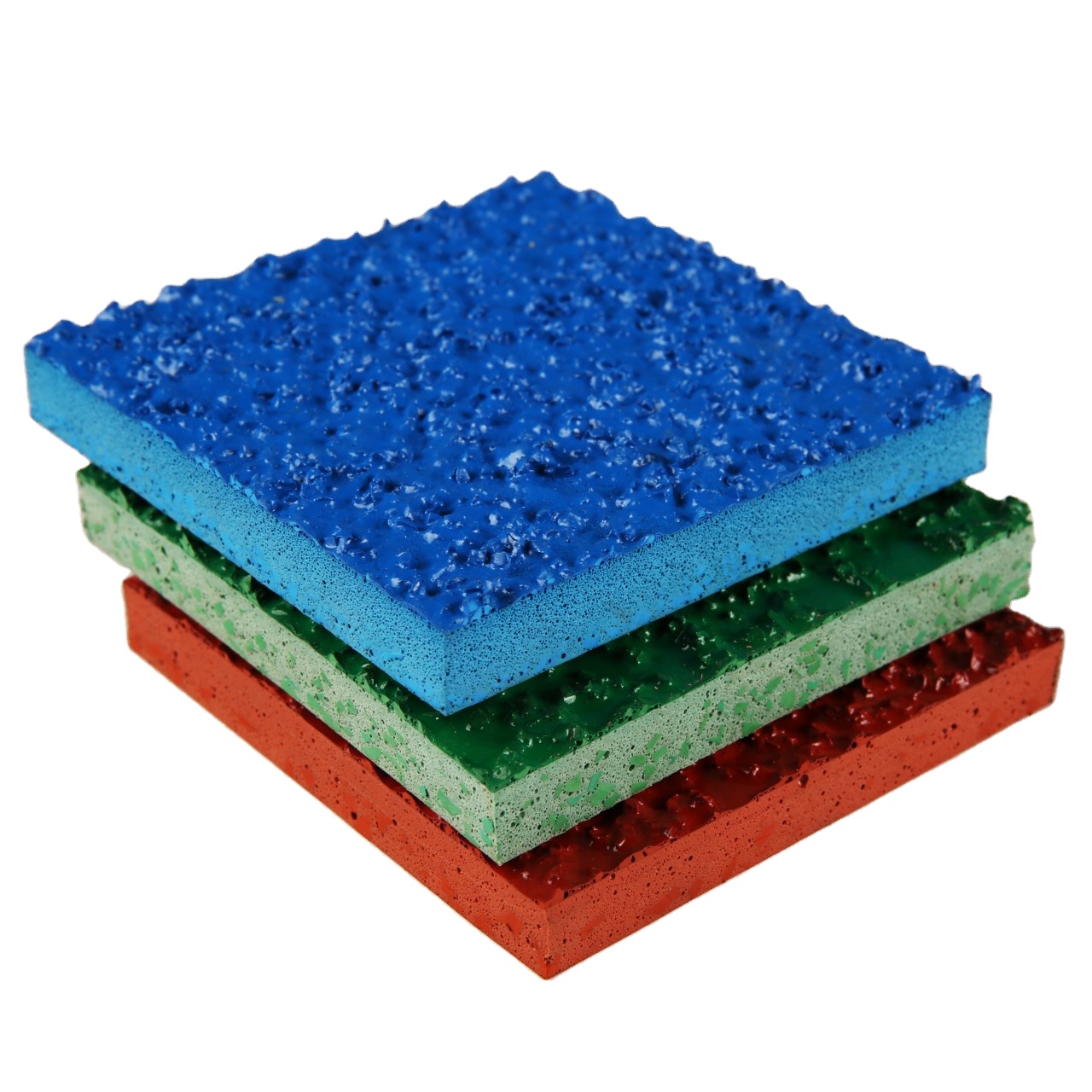
A typical poured-in-place running track consists of multiple layers, each with a distinct role:
Sub-base (asphalt or concrete): Provides structural support and drainage.
Binder/primer coat: Creates adhesion between the sub-base and the elastic layers.
Base elastic layer (often 8–10 mm): A mixture of larger EPDM or SBR granules with PU binder, providing bulk shock absorption and vertical deformation properties.
Wearing surface layer (3–5 mm): A finer EPDM granule layer mixed with PU binder, delivering slip resistance, spike durability, and color definition.
The EPDM granules in the wearing layer are the primary interface between the athlete and the track. Their size, hardness, elasticity, and bonding quality with the PU binder determine how the surface responds to footstrike forces, how well it resists abrasion from spike shoes, and how consistently it maintains its color and texture over years of outdoor exposure.
Why it matters: Running tracks are permanently installed outdoors. UV radiation breaks down pigment molecules and oxidizes the rubber surface over time. Granules with insufficient UV stabilizers will fade unevenly — particularly in lighter colors like blue and yellow — creating a patchy appearance that undermines the visual quality of the facility.
What happens with unsuitable material: Tracks built with low-quality granules may show visible fading within 12–18 months in high-solar regions. The surface may also develop a chalky white residue (chalking), which signals that the rubber matrix itself is degrading, not just the color.
Why it matters: Athletic governing bodies such as World Athletics specify that track surfaces must absorb a defined percentage of impact force. EPDM granules with adequate polymer content (typically ≥20% EPDM by weight) maintain consistent elasticity across temperature ranges, protecting athletes' joints during repetitive footstrikes.
What happens with unsuitable material: Granules with high filler content and low EPDM percentage produce a surface that is too rigid. This increases impact forces transmitted to the athlete's lower limbs, elevating injury risk — particularly for distance runners and jumpers who log high training volumes.
Why it matters: Sprint events generate concentrated spike loads at the starting blocks and along the acceleration zone. Granules with low tensile strength fracture under these loads, leading to granule loss (shedding) and progressive surface thinning.
What happens with unsuitable material: The track develops bare patches in high-traffic zones within the first competition season. Once granules begin shedding, the exposed binder layer degrades faster, accelerating the failure cycle.
Why it matters: Running tracks require precise lane markings and zone colors for competition compliance. Color inconsistency between batches creates visible seams and patching effects. Color instability means the track looks aged prematurely, which affects facility perception and may trigger early (and costly) resurfacing demands from facility owners.
What happens with unsuitable material: Different areas of the same track fade at different rates. Blue sections may shift toward green due to yellowing of the PU binder combining with the blue pigment. White lane lines discolor faster than the main field color, requiring more frequent repainting.
EPDM granules are available in different formulations and particle sizes, each suited to specific layers and track types.
| Feature | Base Layer Granules (2–4 mm) | Wearing Layer Granules (1–3 mm) | Spray-Grade Granules (0.5–2 mm) |
|---|---|---|---|
| Typical Application | Shock-absorbing base course | Top wearing surface | Spray-applied texture coat |
| EPDM Content | 15–20% | 20–30% | 15–25% |
| Particle Size | 2–4 mm | 1–3 mm | 0.5–2 mm |
| Color Options | Red, black, white | Red, green, blue, custom | Red, green, custom |
| UV Resistance | Moderate (covered by wear layer) | High (direct exposure) | High (direct exposure) |
| Elasticity | High (thick, porous structure) | Moderate-high | Moderate |
| Cost | Lower | Higher | Moderate |
| Recommended Use | Breathable-type and sandwich-type tracks | All track types | Breathable-type spray finish |
Which grade fits which project?
Competition-standard tracks (World Athletics certified): Wearing layer granules should have EPDM content ≥25% with verified UV stabilizer packages. Base layer granules at ≥15% EPDM content are typical.
School and community tracks (non-certified): EPDM content of 20% in the wearing layer provides a balance of performance and budget. Base layer can use 15% EPDM or blended SBR/EPDM mixes.
Budget-conscious projects: Base layer granules with lower EPDM content (10–15%) reduce material cost but will shorten service life and reduce shock absorption values. This trade-off should be documented and accepted by the project owner before specification.
No single grade is universally superior. The correct selection depends on the track system type, performance requirements, climate conditions, and budget allocation.
Prevention: Verify granule-binder compatibility with the supplier before ordering. Request granules that have been surface-treated for PU adhesion. Conduct a small-area bond test before full application.
Prevention: Specify granules with minimum 20% EPDM content for the wearing layer. Follow temperature guidelines (10–35°C optimal). Ensure concrete sub-bases have properly sealed expansion joints.
Prevention: Use mechanical mixers for all batches. Maintain consistent granule-to-binder ratios (typically 6:1 by weight for the wearing layer). Avoid surface application during midday in hot climates.
Prevention: Specify aliphatic (non-yellowing) PU binders for the wearing layer. Verify granule EPDM content. Avoid granules that feel excessively hard or produce dust when rubbed between fingers.
Substrate Inspection & Preparation
↓Final Inspection and Handover
Ambient temperature: 10–35°C (do not apply below 5°C or above 35°C)
Relative humidity: ≤85%
Substrate moisture content: ≤5%
No application during rain or when rain is forecast within the curing window


