

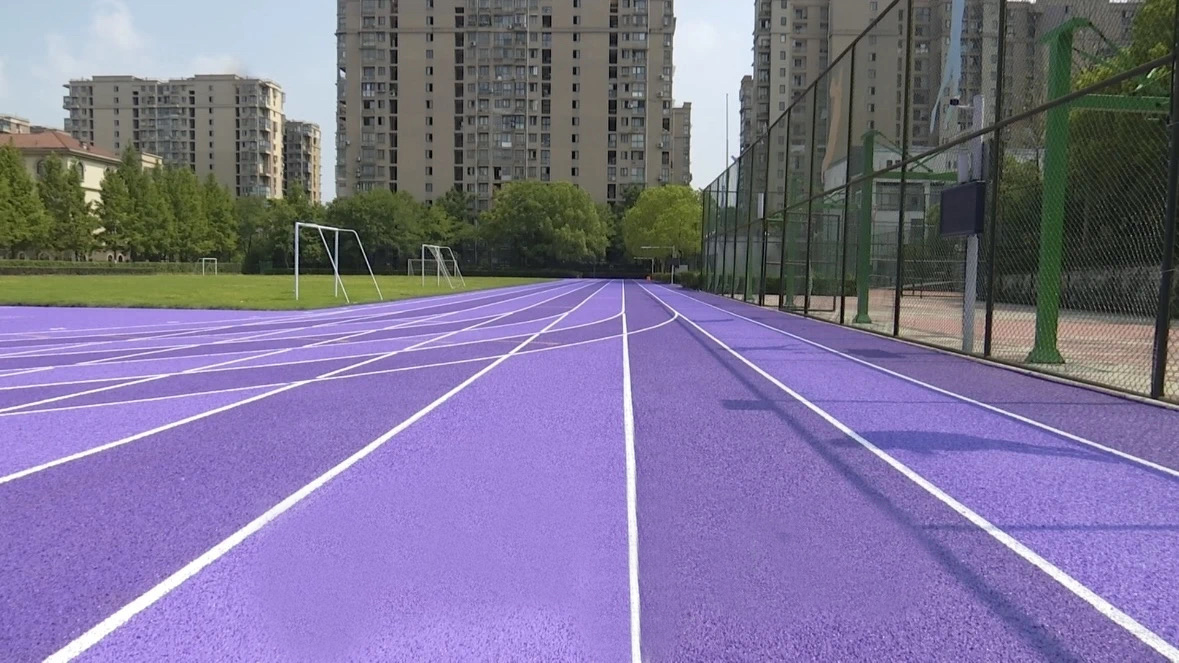
When planning a synthetic running track, one of the most important purchasing questions is:
How much EPDM granules do you need for a running track?
The answer depends on several factors, including the total track area, the thickness of the EPDM surface layer, the density of the rubber granules, the construction method, and the expected material loss during installation.
Buying too little material can cause construction delays and color or particle-size differences between batches.
Buying too much material, on the other hand, can increase storage requirements and project costs.
Therefore, calculating the required amount of EPDM rubber granules before placing an order is an important step for contractors, distributors, and running track project developers.
This guide explains a simple method for estimating EPDM granule requirements and provides practical considerations for purchasing.
The amount of EPDM granules required for a running track is mainly determined by four factors:
Total flooring area
EPDM surface thickness
Material density
Installation loss
The basic calculation is:
EPDM Granules Required = Area × Thickness × Density
An additional percentage should then be added to account for material loss during mixing, transportation, spreading, and installation.
For example, if a project requires 1,000 m² of EPDM surface, the amount of material needed will be significantly different between a 3 mm surface and a 5 mm surface.
Therefore, thickness must be confirmed before calculating the final purchasing quantity.
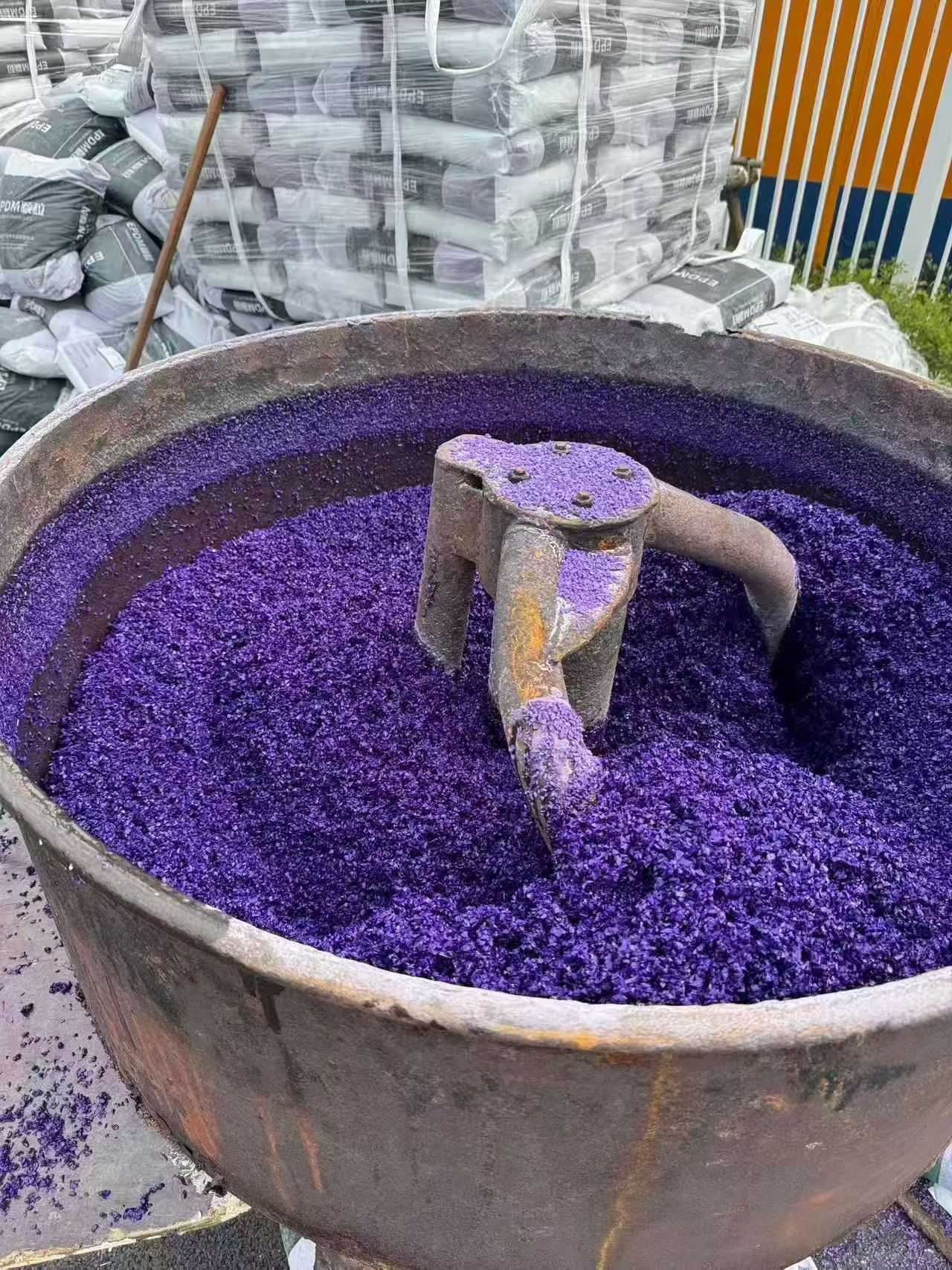
The first step is to determine the total area that will receive the EPDM surface.
For a simple rectangular sports area, the calculation is:
Area = Length × Width
For a standard running track, however, the calculation can be more complicated because the track contains straight sections, curves, lanes, and sometimes additional areas.
Contractors should calculate the actual surface area that will receive EPDM granules rather than simply using the overall site area.
For example:
Track area = 5,000 m²
This means the EPDM surface will cover approximately 5,000 square meters.
If different areas use different surface materials, only the areas requiring EPDM granules should be included in the calculation.
The thickness of the EPDM surface layer has a direct impact on material consumption.
For example, assume a running track requires a 3 mm EPDM surface layer.
The thickness must first be converted into meters:
3 mm = 0.003 m
If the total area is 5,000 m²:
5,000 × 0.003 = 15 m³
This means the theoretical volume of the EPDM layer is approximately 15 cubic meters.
If the specified surface thickness increases to 4 mm:
5,000 × 0.004 = 20 m³
The material requirement therefore increases significantly.
This is why buyers should confirm the required surface thickness with the flooring system manufacturer before ordering materials.
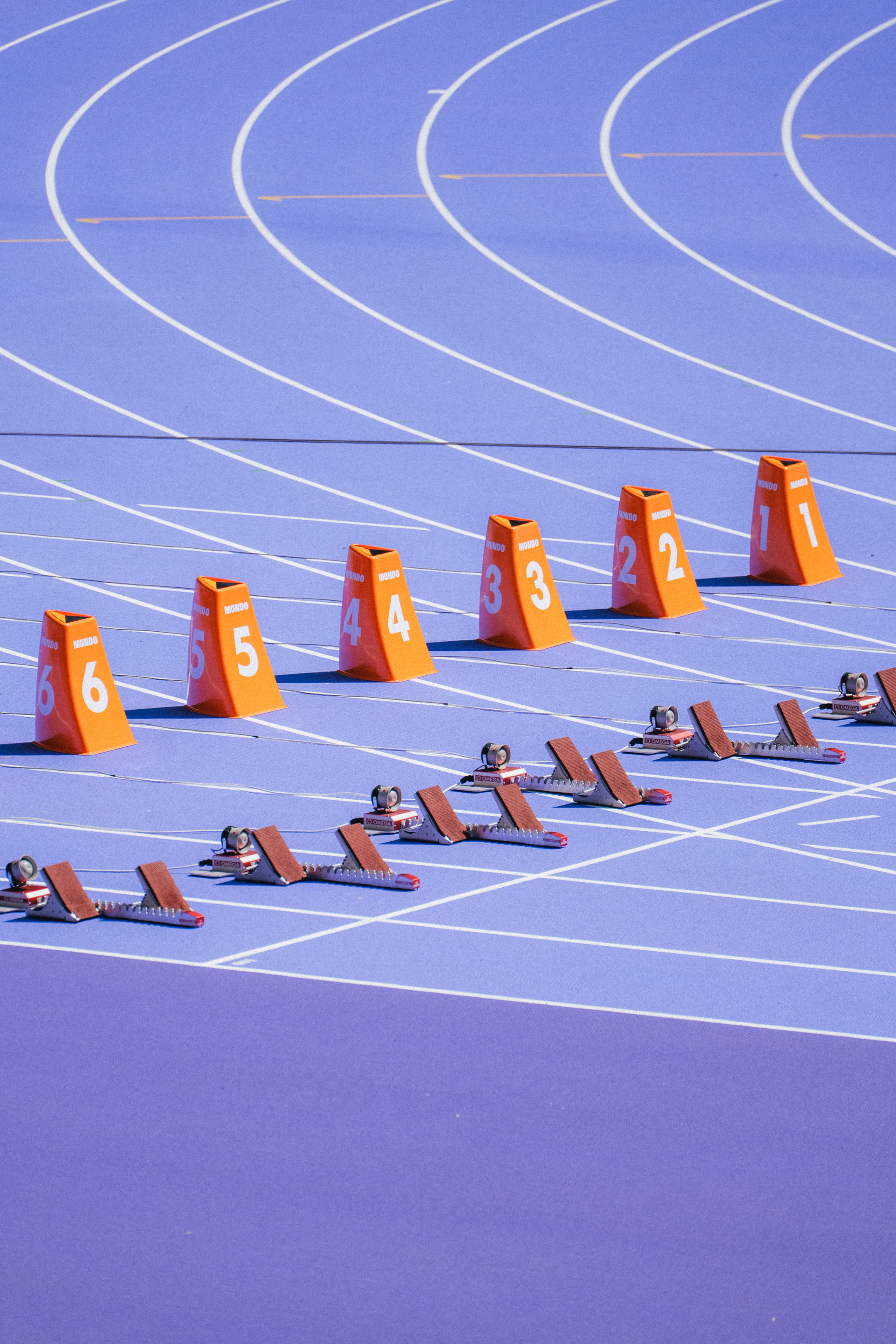
EPDM rubber granules do not all have exactly the same density.
Density can vary depending on the formulation, color, particle size, production process, and specific product.
Therefore, buyers should use the actual bulk density provided by their EPDM granule supplier whenever possible.
For estimation purposes, assume the bulk density is 600 kg/m³.
Using the previous example:
15 m³ × 600 kg/m³ = 9,000 kg
Therefore, the theoretical requirement would be approximately:
9,000 kg of EPDM granules
However, this is only a basic theoretical calculation.
The actual consumption may be different because EPDM granules are loose particles rather than a solid block of rubber.
Material loss should be considered when preparing a purchase order.
During a real construction project, some EPDM granules may be lost during:
Transportation
Mixing
Handling
Spreading
Edge trimming
Equipment cleaning
Surface adjustment
A practical project estimate may therefore include an additional allowance, such as 3–10%, depending on the construction method and project conditions.
For example, if the calculated requirement is 9,000 kg and the contractor allows 5% for installation loss:
9,000 × 1.05 = 9,450 kg
The estimated purchasing quantity would therefore be approximately 9,450 kg.
The actual allowance should be determined by the contractor according to the project conditions and installation experience.
Let's consider a simplified project.
Total EPDM surface area: 5,000 m²
EPDM surface thickness: 3 mm
Estimated bulk density: 600 kg/m³
Estimated installation loss: 5%
First, calculate the volume:
5,000 × 0.003 = 15 m³
Then calculate the theoretical material weight:
15 × 600 = 9,000 kg
Finally, add 5% installation allowance:
9,000 × 1.05 = 9,450 kg
Therefore, the estimated purchasing requirement is approximately:
9.45 tons of EPDM rubber granules
This example is intended for estimation only.
For an actual project, the supplier's measured bulk density and the project's specified construction thickness should be used for the final calculation.
EPDM rubber granules are available in different particle sizes, such as:
1–2 mm
1–3 mm
1–4 mm
2–4 mm
3–5 mm
Particle size can affect the packing characteristics and surface appearance of the flooring.
Smaller and larger particles may have different bulk densities and packing behavior.
Therefore, two EPDM products with the same nominal volume may not necessarily have exactly the same weight.
For accurate purchasing calculations, it is better to obtain the supplier's technical data rather than using a generic density value.
EPDM granules are commonly combined with PU binder to create a synthetic running track surface.
The amount of PU binder required depends on the EPDM granule type, particle size, installation method, desired surface structure, and manufacturer's recommended mixing ratio.
For example, if the recommended binder ratio is calculated according to the weight of EPDM granules, the contractor can estimate PU binder consumption after determining the total EPDM requirement.
If a project requires 9,450 kg of EPDM granules and the specified binder ratio is 10% by weight:
9,450 × 10% = 945 kg
The estimated PU binder requirement would therefore be approximately 945 kg.
However, the actual ratio must always be based on the technical specification of the selected EPDM and PU binder system.
Different products may require different ratios.
A common purchasing mistake is to calculate EPDM consumption only according to square meters.
For example, a buyer may say:
“We need 5,000 m² of running track. How many tons of EPDM do we need?”
This information alone is not enough.
The supplier also needs to know:
Surface thickness
EPDM particle size
Product density
Construction method
Required color
Binder ratio
Expected material loss
Without these details, the estimated quantity may be inaccurate.
For this reason, contractors should provide as much project information as possible when requesting a quotation.
When requesting an EPDM granule quotation, buyers should ideally provide the following information:
Project Area | Provide the total surface area in square meters. |
Surface Thickness | Specify the required EPDM layer thickness. |
Particle Size | Indicate the required granule size. |
Color | Specify the desired EPDM color or color combination. |
Application | Explain whether the material will be used for a running track, playground, basketball court, walking path, or another sports surface. |
PU Binder | If the project uses polyurethane binder, provide the expected binder type or mixing ratio if already specified. |
Efficient material management can help control project costs.
First, accurately measure the actual installation area.
Second, confirm the required surface thickness before purchasing.
Third, use calibrated weighing equipment when preparing the EPDM and PU binder mixture.
Fourth, maintain a consistent mixing process.
Finally, purchase materials with an appropriate allowance rather than adding excessive quantities.
For large projects, maintaining the same EPDM color, particle size, and product specification throughout the project is also important.
This can help prevent visible differences between different production batches.
Generic online calculations can provide a useful starting point, but they should not replace product-specific technical data.
A professional EPDM rubber granules manufacturer should be able to provide information such as:
Particle size
Bulk density
Color options
Technical specifications
Recommended applications
Packaging options
PU binder compatibility
Product samples
Quality control information
For large running track projects, buyers should request samples and technical documentation before confirming a large purchase.
Calculating how much EPDM granules you need for a running track requires more than simply knowing the total track area.
The most important factors are the surface area, EPDM layer thickness, bulk density, particle size, installation method, and expected material loss.
The basic calculation can be summarized as:
EPDM Required = Area × Thickness × Density × (1 + Loss Allowance)
For example, a 5,000 m² surface with a 3 mm EPDM layer and an estimated bulk density of 600 kg/m³ would require approximately 9,000 kg theoretically, or around 9,450 kg after adding a 5% installation allowance.
However, actual consumption should always be confirmed using the specific product's technical data and the flooring system manufacturer's recommendations.
For contractors and project developers, accurate EPDM calculation can help reduce material waste, control purchasing costs, and avoid construction delays.
By working with an experienced EPDM rubber granules manufacturer and providing complete project specifications, buyers can obtain a more accurate material estimate and select the appropriate EPDM granules and PU binder for their running track project.


